Introduction
The Central Public Works Department (CPWD) works on various construction, infrastructure, electrical, civil, and maintenance projects across India. Businesses supplying eligible products to government projects may need to complete the applicable registration or approval process before participating in relevant opportunities.
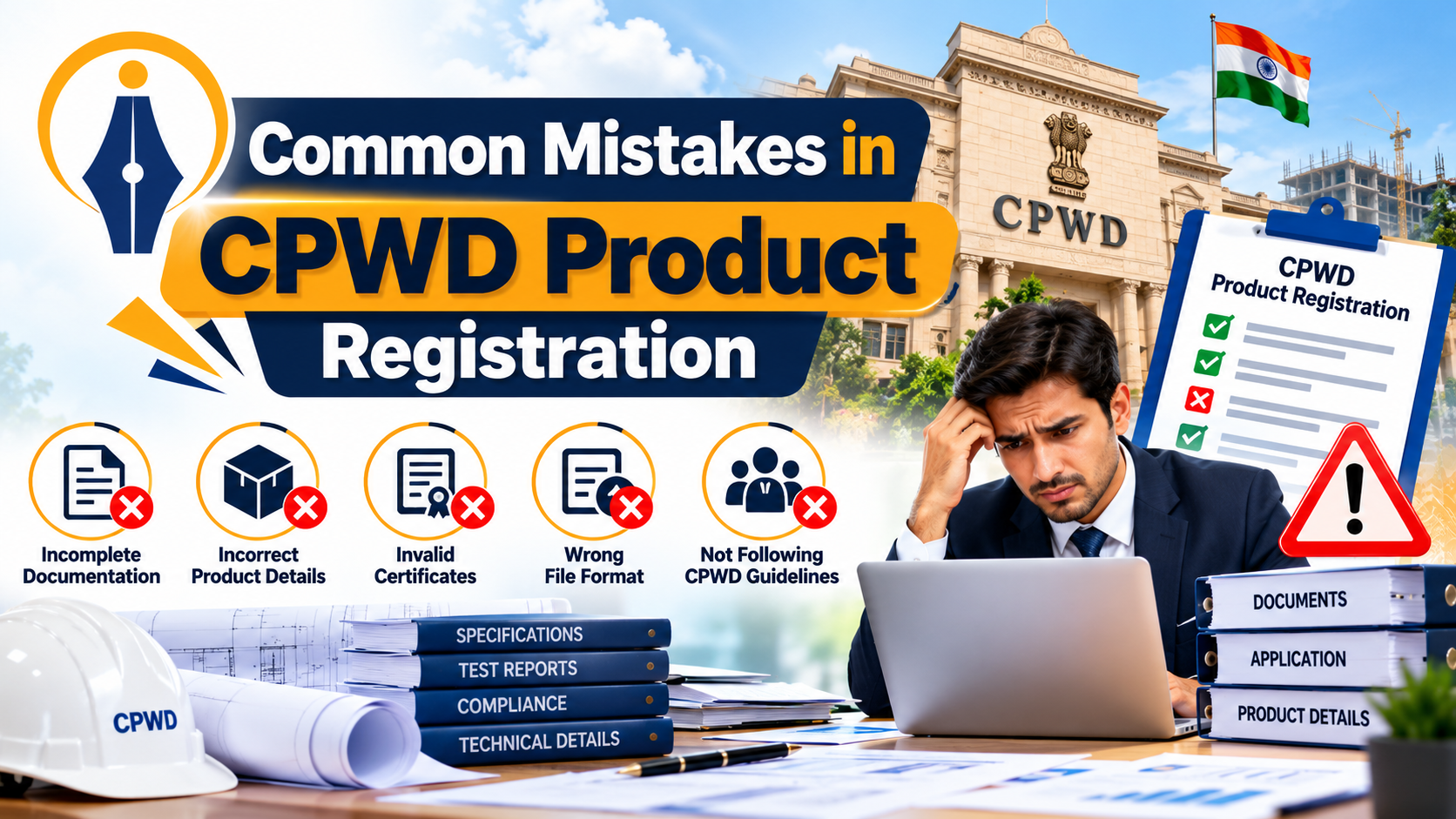
While the registration process can be straightforward when the documentation is properly prepared, small mistakes can lead to queries, delays, or rejection. Understanding these common errors can help applicants prepare their applications more carefully.
1. Submitting Incomplete Documents
One of the most common mistakes is submitting an incomplete set of documents. Applicants may forget important business, product, financial, or technical documents required for the particular registration or category.
Before submission, businesses should prepare a document checklist and verify that all required documents are available, valid, and properly signed wherever applicable.
2. Providing Incorrect Company Details
The company name, registered address, PAN, GST details, contact information, and other business particulars should be consistent across the application and supporting documents.
Differences in spelling, addresses, business names, or registration details can create unnecessary clarification requirements.
3. Incorrect Product Information
Product-related information is an important part of the registration process. Applicants sometimes provide incomplete specifications, incorrect model numbers, outdated product details, or descriptions that do not match the supporting documents.
The product description, technical specifications, brand details, catalogue, and other relevant information should be carefully checked before submission.
4. Ignoring Technical Documents
Depending on the product category and applicable requirements, technical documents may be important for establishing product quality and suitability.
Applicants should ensure that relevant test reports, certifications, catalogues, specifications, quality documents, or other supporting records are properly arranged and valid where required.
5. Uploading Poor-Quality Documents
Scanned documents that are blurred, cut off, illegible, or improperly formatted can make verification difficult. This is especially important for certificates, financial documents, identity documents, and technical records.
Applicants should use clear and readable copies and check every document before uploading or submitting it.
6. Not Checking Financial Documents
For certain registrations or government procurement requirements, financial information may be relevant. Businesses sometimes submit outdated balance sheets, incomplete financial records, or documents that do not match the information provided in the application.
Financial documents should be current and properly arranged according to the applicable requirements.
7. Using Mismatched Information
Consistency is essential throughout the application. For example, the product name mentioned in the application should correspond with the product catalogue and supporting documents.
Similarly, company and proprietor/director/partner details should be checked carefully wherever applicable.
8. Applying Without Checking Eligibility
Another common mistake is starting the application without first checking whether the business and product meet the applicable eligibility conditions.
Before applying, applicants should review the relevant CPWD requirements, product category, technical conditions, and supporting documentation needed for their specific case.
9. Not Responding Properly to Queries
If the department raises an objection or asks for additional information, the applicant should respond within the applicable timeline and provide accurate supporting documents.
An incomplete or unclear response can cause further delays.
How to Avoid These Mistakes
Businesses can reduce the chances of delays by following a simple process:
- Check the applicable CPWD requirements before applying.
- Prepare all required documents in advance.
- Verify company and product details carefully.
- Keep technical and financial documents ready.
- Upload clear and readable copies.
- Ensure consistency across all documents.
- Review the application before final submission.
- Respond carefully to departmental queries.
Conclusion
CPWD Product Registration requires careful documentation and accurate information. Common mistakes such as incomplete documents, incorrect product details, poor-quality scans, mismatched information, and inadequate responses to queries can make the process more difficult.
Need Help With Tender Filing?
Get expert assistance for tender search, documentation, eligibility checks and bid submission.
