Introduction
The Government e-Marketplace (GeM) is a digital procurement platform used by government
departments, public sector organisations, and other eligible buyers to purchase products and
services. Sellers and service providers can participate in online bids and reverse auctions to
access government procurement opportunities.
However, submitting a bid on GeM requires careful preparation. A competitive price alone is not
enough. Buyers may evaluate technical specifications, eligibility criteria, supporting documents,
delivery conditions, and other requirements mentioned in the bid.
1. Not Reading the Complete Bid Document
One of the most common mistakes is reviewing only the bid title or product description.
Important conditions may be included in the technical specifications, Additional Terms and
Conditions (ATC), Special Terms and Conditions (STC), or attached documents.
Before bidding, carefully check:
Eligibility requirements
Technical specifications
Quantity and delivery location
Required certificates
Experience and turnover conditions
Warranty and service obligations
Payment terms
Performance security requirements
A seller should participate only after confirming that all applicable requirements can be fulfilled.
2. Ignoring Corrigenda and Amendments
Buyers may issue corrigenda, clarifications, or amendments after a bid is published. These
updates may change the submission deadline, specifications, eligibility conditions, or other
important terms.
Ignoring such updates can result in submitting an outdated or non-compliant bid. Sellers should
regularly check the official GeM bid page and review all amendments before final submission.
3. Uploading Incomplete or Incorrect Documents
Document-related errors are a major reason for technical disqualification. Common problems
include:
Missing mandatory documents
Expired certificates
Unreadable files
Incorrect company details
Mismatched PAN or GST information
Missing authorisation letters
Incorrect experience certificates
Documents belonging to another entity
Prepare a bid-specific document checklist and verify every file before uploading it.
4. Assuming GeM Product Listing Means Automatic
Eligibility
Having a product or service listed on GeM does not automatically mean that the seller qualifies
for every bid. Each bid may have separate technical, financial, and eligibility requirements.
For example, a bid may require specific certifications, brand authorisation, previous experience,
local service support, or particular technical features.
Always compare the listed product or service with the exact requirements of the bid.
5. Misunderstanding MSE, Startup, and Other Benefits
Some sellers assume that MSME, startup, or other registrations automatically provide exemption
or preference in every GeM bid.
However, the availability of such benefits depends on the applicable procurement policy and the
conditions specified in the particular bid. Sellers should verify whether the required registration,
declaration, or supporting documents are applicable.
Do not claim an exemption or preference without checking the relevant conditions.
6. Quoting Prices Without Calculating the Complete Cost
A low quotation may appear competitive but can create losses if important expenses are ignored.
Before submitting a price, consider:
GST and applicable taxes
Transportation and freight
Packaging
Installation and commissioning
Warranty and after-sales service
Manpower and consumables
Travel expenses
Delivery to multiple locations
Other contractual obligations
A complete cost calculation helps businesses submit commercially sustainable bids.
7. Entering a Reverse Auction Without a Price Strategy
Reverse auctions involve price competition among eligible sellers. Entering an auction without
understanding the pricing limits can lead to unplanned price reductions.
Before participating, determine the lowest price at which the contract can be fulfilled profitably.
Consider the applicable auction rules, price decrement, and extension conditions.
Price competition should not compromise the quality of service or the ability to fulfil contractual
obligations.
8. Reusing Old Documents Without Verification
Using documents from previous bids can save time, but copying them without checking may
create errors. Old files may contain:
Incorrect bid numbers
Previous buyer details
Expired certificates
Outdated specifications
Wrong company information
Old pricing or commercial terms
Previous documents should be used only as references. Every new bid requires a fresh
compliance review.
9. Uploading Documents in the Wrong Section
Some bids require technical and financial information to be submitted separately. Uploading
documents in the wrong section or failing to follow the prescribed format may affect the
evaluation process.
Before uploading, confirm:
Which documents belong in each section
Whether the financial bid must be submitted separately
Whether a prescribed BOQ or price format is required
Whether file size and format conditions are satisfied
Follow the exact instructions mentioned in the bid.
10. Waiting Until the Last Minute
Submitting a bid close to the deadline can be risky. Internet issues, portal problems, document
upload errors, or technical difficulties may delay the process.
Complete the submission well before the deadline and verify that the bid has been successfully
submitted. Save the final acknowledgement or submission record for future reference.
How to Avoid Common GeM Bidding Mistakes
A simple pre-submission checklist can help reduce errors:
1. Read the complete bid document.
2. Check all corrigenda and amendments.
3. Verify technical and eligibility requirements.
4. Prepare all mandatory documents.
5. Check PAN, GST, company name, and other details.
6. Calculate the complete cost before quoting.
7. Review exemption and preference conditions.
8. Upload documents in the correct sections.
9. Submit the bid before the deadline.
10. Save the final submission acknowledgement.
Conclusion
GeM bidding can provide valuable procurement opportunities, but success requires careful
planning and compliance. Most avoidable mistakes occur because sellers overlook bid
conditions, submit incomplete documents, misunderstand eligibility requirements, or rush the
final submission.
GeM Registration & Tender Bidding
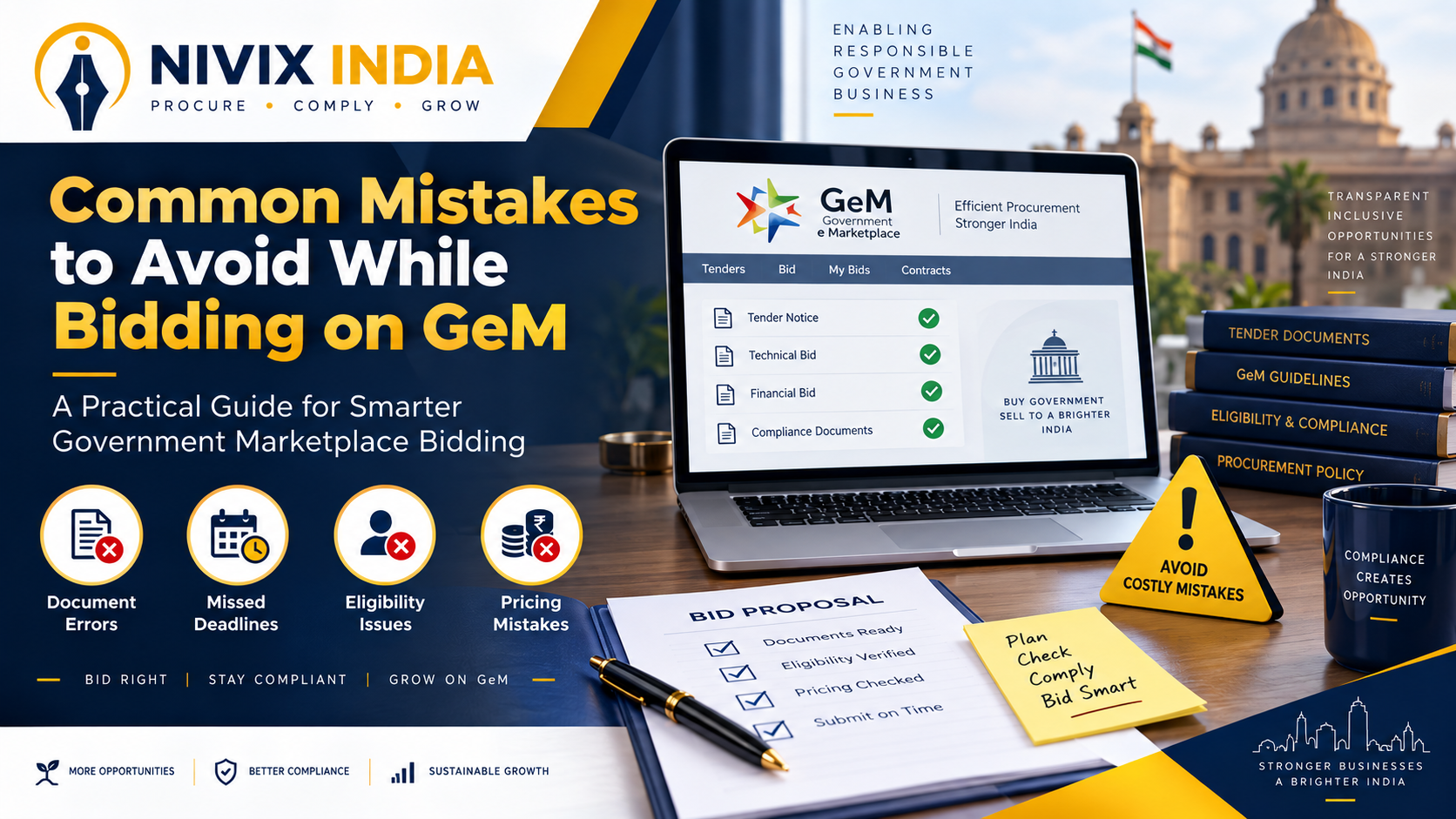
Common Mistakes to Avoid While Bidding on GeM
Bidding on the Government e-Marketplace (GeM) gives businesses an opportunity to participate in government procurement. However, incomplete documents, missed deadlines, incorrect pricing, and failure to follow bid conditions can lead to disqualification. This guide explains the common mistakes to avoid while bidding on GeM.
