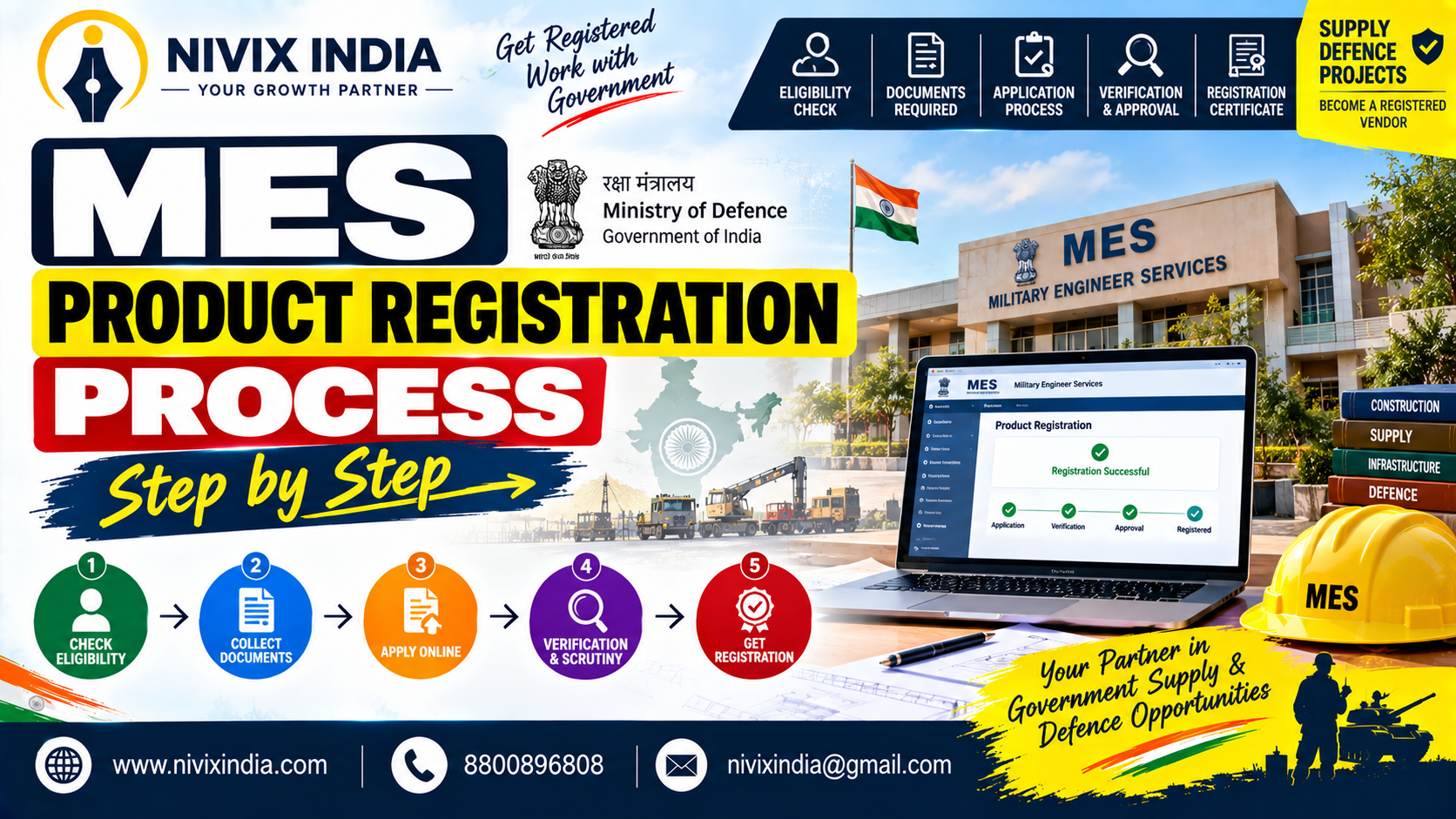
What is MES Product Registration?
MES Product Registration is a process through which eligible manufacturers, suppliers, and businesses can submit their product details and supporting documents for consideration in relevant MES requirements.
Depending on the product category and applicable procurement procedure, the department may examine the supplier's technical specifications, quality documents, manufacturing capability, previous experience, and other relevant information.
Who Can Apply for MES Product Registration?
Businesses that manufacture or supply products relevant to MES requirements may explore product registration opportunities.
Generally, applicants may include:
- Manufacturers
- Authorized dealers
- Suppliers
- Product manufacturers with established quality standards
- Engineering and infrastructure product companies
- Specialized equipment and material suppliers
The applicable eligibility conditions can vary according to the product and the particular MES requirement.
MES Product Registration Process – Step by StepStep 1: Identify the Product Category
The first step is to identify the exact product or product category for which you want to approach MES.
Prepare complete information about the product, including:
- Product name
- Model or specification
- Technical details
- Brand or manufacturer details
- Applicable standards
- Product catalogue
- Testing and quality information
Accurate product classification is important because requirements can differ between product categories.
Step 2: Check Eligibility and Requirements
Before submitting an application, review the applicable MES requirements and eligibility conditions.
The business should verify whether it meets the relevant requirements relating to:
- Manufacturing or supply capability
- Technical specifications
- Quality standards
- Previous experience
- Financial capacity
- Statutory registrations
- Product testing or certification
Step 3: Prepare Required Documents
The applicant should keep its business and product documents ready before starting the registration process.
Commonly required documents may include:
- Company/firm registration documents
- PAN Card
- GST Registration Certificate
- Product catalogue
- Technical specifications
- Product test reports, where applicable
- Quality certificates
- Manufacturer authorization, where applicable
- Previous supply/work orders, if required
- Experience certificates, where applicable
- Bank details
- Address proof
- Contact details
The exact document requirement may vary depending on the product and applicable MES procedure.
Step 4: Prepare Product Technical Details
Product information should be clear and technically accurate.
A proper product submission may include:
- Product description
- Technical specifications
- Dimensions
- Material details
- Capacity/performance
- Applicable standards
- Brand and model
- Test reports
- Warranty information, where applicable
- Product photographs/catalogue
Incomplete or inconsistent technical information may lead to clarification requests or rejection.
Step 5: Submit the Application
After preparing the required documents, the application can be submitted through the applicable MES procedure or platform, depending on the product category and current departmental requirements.
All information should be checked carefully before submission. Names, addresses, registration details, product specifications, and supporting documents should be consistent.
Step 6: Departmental Scrutiny
After submission, the concerned authority may examine the application and documents.
The scrutiny may involve verification of:
- Applicant details
- Product specifications
- Technical documents
- Quality certificates
- Experience
- Manufacturing/supply capability
- Other eligibility requirements
If clarification or additional documents are required, the applicant should provide them within the specified time.
Step 7: Technical Evaluation or Inspection
For certain products, additional technical evaluation, testing, inspection, demonstration, or verification may be applicable.
The exact procedure depends on the product category and the requirements prescribed by the concerned authority.
Step 8: Registration/Approval as Applicable
If the application satisfies the applicable requirements, the product or supplier may be registered/approved as per the relevant MES procedure.
The applicant should carefully maintain the registration or approval records for future procurement opportunities.
Common Reasons for Delay or ClarificationBusinesses should avoid common documentation mistakes such as:
- Incorrect company details
- Mismatch in business documents
- Incomplete product specifications
- Missing test reports
- Expired certificates
- Unclear product catalogues
- Incorrect authorization documents
- Missing experience documents
- Uploading incomplete or unreadable documents
Proper document preparation can help reduce avoidable clarification issues.
How Nivix India Can HelpNivix India provides professional assistance for government registration, tender documentation, product registration, and procurement-related processes.
Our support can include:
- Understanding applicable requirements
- Document checklist preparation
- Application documentation
- Product information preparation
- Registration assistance
- Clarification support
- Government tender and procurement guidance
Businesses should always verify the latest requirements applicable to their specific product before submitting an application.
ConclusionThe MES Product Registration Process requires proper product information, accurate business documentation, and compliance with the applicable requirements. From identifying the correct product category to preparing technical documents and completing departmental scrutiny, each step should be handled carefully.
Need Help With Tender Filing?
Get expert assistance for tender search, documentation, eligibility checks and bid submission.
