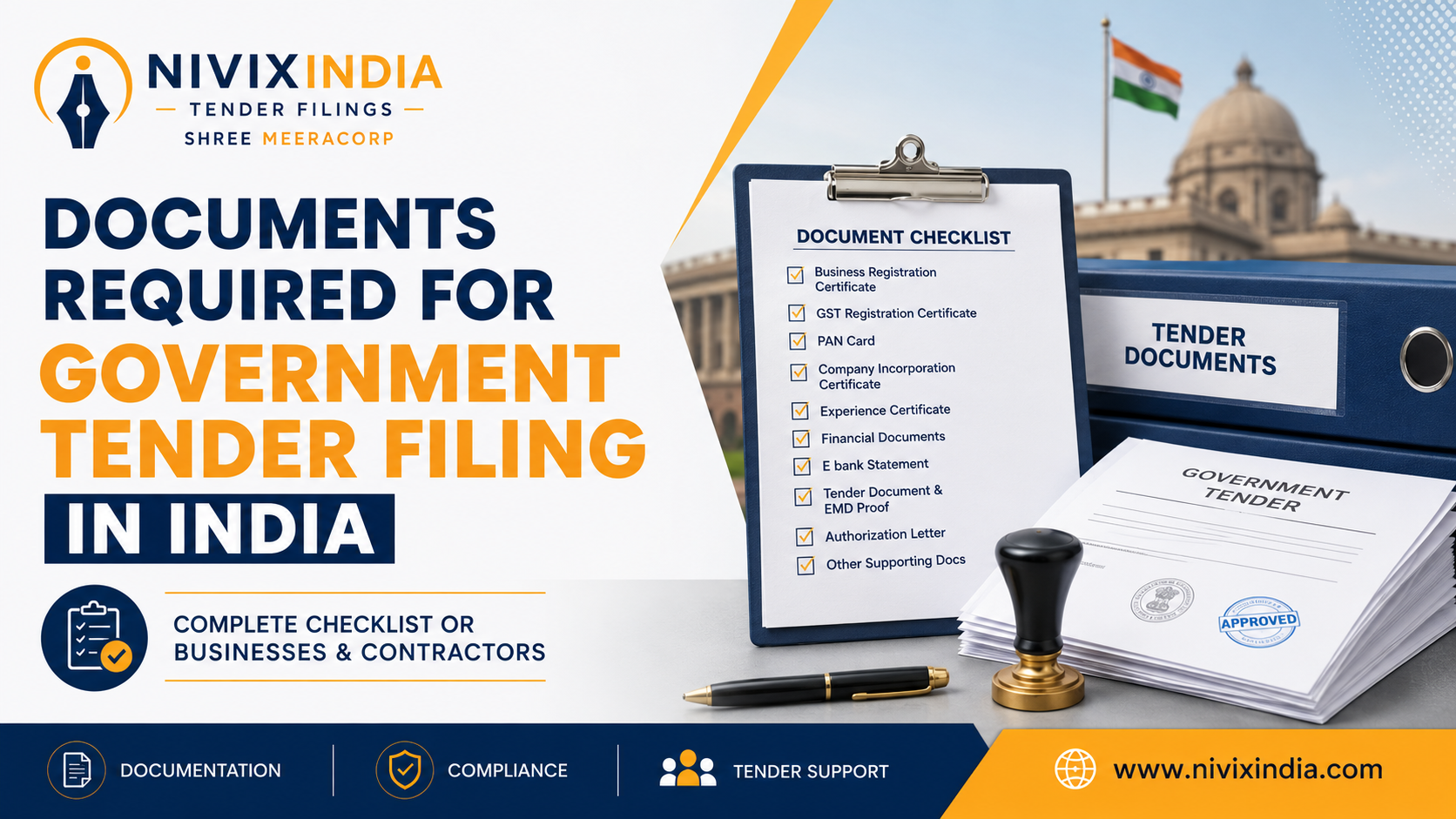
The essential documents required for government tender filing are as:
1. Business Registration Documents
• Certificate of Incorporation (Company)
• Partnership Deed (Partnership Firm)
• LLP Incorporation Certificate
• Proprietorship Declaration (if applicable)
• PAN Card of the Business
• GST Registration Certificate
• UDYAM/MSME Registration (if available)
• Shop & Establishment Certificate (where applicable)
2. Identity Proof of Authorized Person
• Aadhaar Card
• PAN Card
• Passport (if applicable)
• Driving Licence
• Voter ID
3. Digital Signature Certificate (DSC)
A valid Class 3 Digital Signature Certificate (DSC) is generally required for bidding the tender which are as
• Login
• Bid submission
• Document signing • Online authentication
4. Income Tax Documents
• Income Tax Returns (ITR)
• PAN Details
5. GST Registration certificate 6. Bank Documents
• Cancelled Cheque
• Bank Account Details
• Bank Solvency Certificate (where applicable)
• Bank Guarantee (if specified)
7. Authorization Documents
• Board Resolution
• Power of Attorney (POA)
• Authorization Letter Department-Specific Documents
• OEM Authorization
• Manufacturer Authorization
• Factory Licence
• BIS Certification
• Pollution Clearance
• Labour Licence
• Electrical Licence
• Contractor Registration
• Professional Tax Registration
• EPF Registration
• ESIC Registration
• Frequently Asked Questions (FAQs)
1. Is GST registration compulsory for every government tender?
Not always. The requirement depends on the eligibility conditions mentioned in the tender document.
2. Can a new business apply for government tenders?
Yes. Many tenders are open to new businesses, provided they meet the eligibility criteria specified by the issuing authority.
3. Why is a Digital Signature Certificate (DSC) important?
A DSC enables secure online authentication and is generally required for signing and submitting electronic bids.
4. Is an MSME certificate mandatory?
No. However, eligible MSMEs may receive certain benefits, such as exemptions or relaxations, where permitted by the tender conditions.
5. What is an Earnest Money Deposit (EMD)?
EMD is a refundable security deposit that demonstrates the seriousness of the bidder. Some eligible categories may receive exemptions as per applicable rules.
Declaration
The information provided in this article is intended for general educational and informational purposes only. Document requirements differ across government departments, organizations, and individual tenders. Applicants should carefully review the official tender notice, bid document, and eligibility conditions before preparing or submitting their bids.
Tender Filing
Documents Required for Government Tender Filing in India
The participation in government tenders is a great opportunity for businesses to secure long-term projects from Central Government, State Government, PSUs, Railways, Defence, Municipal Corporations, and other public authorities. However, before submitting a bid, every bidder must arrange the required documents properly.
