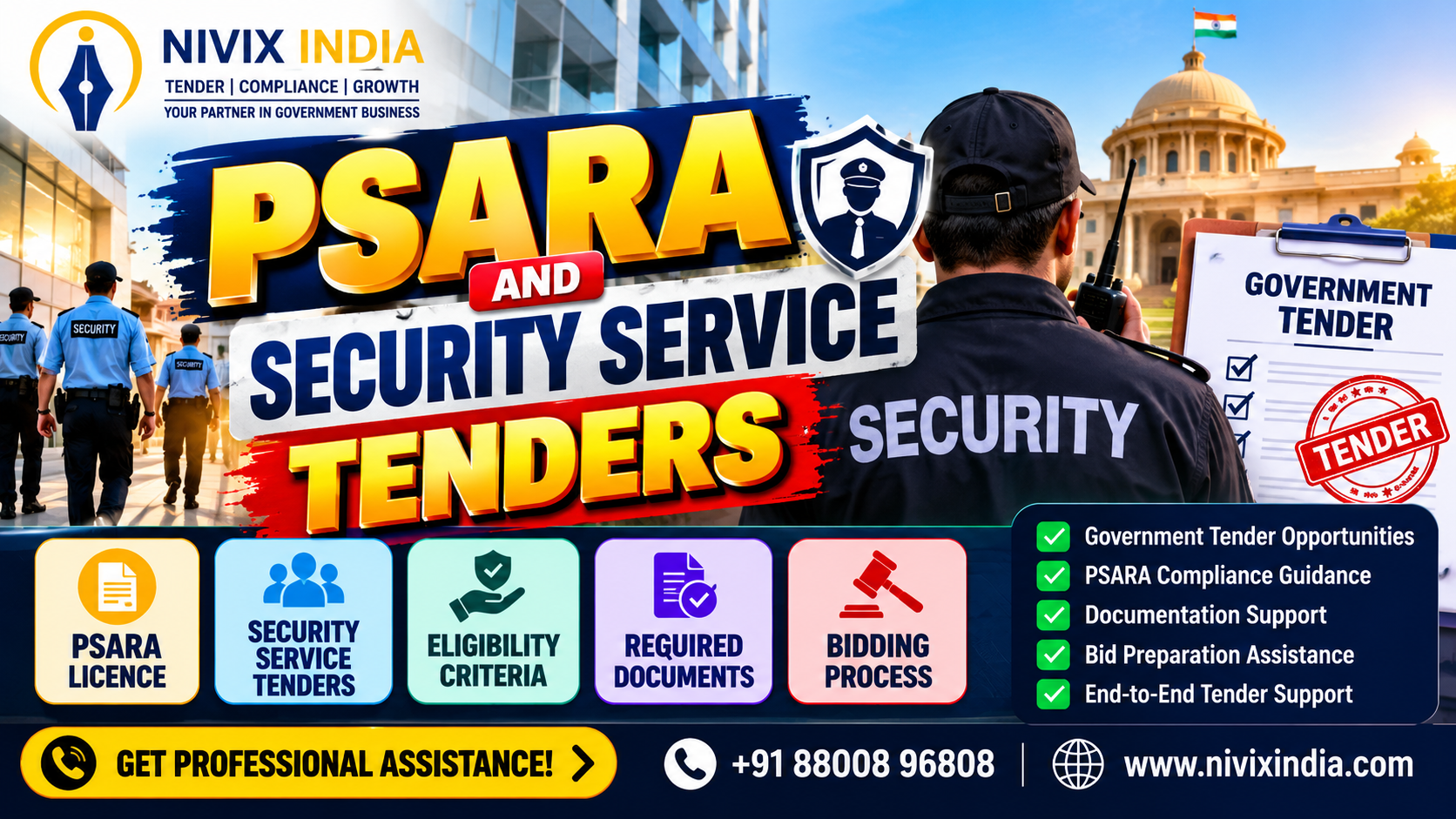
What Is PSARA?
PSARA refers to the Private Security Agencies (Regulation) Act, 2005. It regulates private security agencies that provide security services in India.
Under the Act, a private security agency generally needs to obtain a licence from the competent authority of the relevant state or Union Territory before commencing or carrying on its business, subject to applicable legal provisions and exemptions.
The licence requirements may vary according to the state, area of operation, and applicable rules.
A PSARA licence helps demonstrate that an agency has fulfilled the relevant licensing requirements. However, it does not automatically guarantee eligibility or selection in every government tender.
What Are Security Service Tenders?
Security service tenders are procurement opportunities issued by government departments, public sector undertakings, government institutions, and other organisations to hire eligible security service providers.
These tenders may cover services such as:
- Security guards for government offices and buildings.
- Security personnel for hospitals, colleges, and universities.
- Security services for industrial plants and warehouses.
- Security arrangements for public institutions and residential premises.
- Armed or specialised security services, where legally permitted and specifically required.
- Security supervisors and manpower management services.
Tender conditions differ between organisations. Agencies should carefully review the scope of work, qualification criteria, contract duration, manpower strength, and financial obligations before submitting a bid.
Why Is PSARA Important for Security Tenders?
Many security service tenders require bidders to submit a valid PSARA licence covering the relevant state or operational area. Some tenders may also specify additional conditions related to experience, financial capacity, manpower, and statutory compliance.
A valid licence can help an agency meet the licensing requirement, but the bidder must satisfy all other tender conditions as well.
Before participating, businesses should check:
- Whether the tender requires a PSARA licence.
- Whether the licence covers the required state or area.
- Whether the licence is valid on the relevant date.
- Whether the tender specifies previous experience or turnover.
- Whether the bidder must provide EPF, ESI, GST, and other compliance documents.
- Whether an Earnest Money Deposit (EMD), performance security, or other financial commitment is required.
The exact document list depends on the tender authority and its eligibility conditions. Commonly requested documents include:
- PSARA licence.
- Certificate of Incorporation or business registration proof.
- PAN card of the business.
- GST registration certificate, where applicable.
- Bank details and cancelled cheque.
- Income tax returns and financial statements, if required.
- Turnover certificate or CA-certified financial documents, if specified.
- EPF and ESI registration details, where applicable.
- Previous work orders and performance certificates, if experience is required.
- Details of security guards, supervisors, and manpower availability.
- Affidavits, declarations, and undertakings in the prescribed format.
- Digital Signature Certificate (DSC), where required for online bidding.
- EMD or exemption documents, if permitted under the tender conditions.
Agencies should upload clear, valid, and consistent documents. Differences in business names, licence details, addresses, or financial information may result in clarification requests or rejection.
How to Participate in Security Service TendersStep 1: Obtain the Applicable PSARA Licence
Check the relevant state licensing requirements and apply to the competent authority. Complete the prescribed formalities, training requirements, and documentation applicable to the agency.
Step 2: Identify Suitable Government Tenders
Search official procurement portals, department websites, and the Government e-Marketplace (GeM), where relevant security service opportunities are published.
Step 3: Review the Tender Eligibility
Read the complete tender document, including technical qualifications, experience requirements, minimum turnover, manpower strength, wage conditions, EMD, and submission deadlines.
Step 4: Prepare the Technical Bid
Arrange the PSARA licence, business registration documents, statutory registrations, experience proofs, declarations, and other documents requested by the tender authority.
Step 5: Prepare the Financial Bid
Submit the price bid according to the prescribed format. Consider minimum wages, statutory contributions, uniforms, equipment, supervision, administrative costs, taxes, and other contract expenses before quoting.
Step 6: Submit the Bid Online
Register on the relevant portal, complete the required bidder details, use the prescribed digital signature where applicable, and upload all documents before the deadline.
Step 7: Track the Tender Status
Monitor technical evaluation, clarification requests, financial bid opening, award announcements, and any additional requirements communicated by the authority.
Common Mistakes to AvoidSecurity agencies may face difficulties during tender evaluation because of avoidable errors. Common mistakes include:
- Applying for a tender without checking the PSARA licence requirement.
- Submitting an expired or unsuitable licence.
- Ignoring minimum experience or turnover criteria.
- Uploading incomplete or unsigned declarations.
- Quoting prices without considering statutory wage obligations.
- Missing EMD or performance security requirements.
- Uploading documents in the wrong format.
- Submitting the bid after the deadline.
- Failing to review amendments, corrigenda, or pre-bid clarifications.
A document checklist and a final review before submission can help reduce these risks.
How Nivix India Can HelpNivix India provides professional assistance to businesses seeking support with government tender documentation and online bidding preparation.
Our assistance may include:
- Tender identification and basic eligibility review.
- Security service tender document checklist preparation.
- Assistance with organising business and statutory documents.
- Technical bid documentation support.
- Guidance on online tender submission procedures.
- Assistance in reviewing tender requirements and submission deadlines.
The scope of assistance depends on the specific tender and the documents provided by the client. Licensing decisions, tender acceptance, and contract awards remain subject to the relevant authorities and their evaluation criteria.
ConclusionPSARA licensing and security service tenders are important considerations for private security agencies planning to work with government departments and institutional clients. A suitable licence, complete documentation, careful eligibility review, and a properly prepared bid can help businesses participate more effectively in the tendering process.
Need Help With Tender Filing?
Get expert assistance for tender search, documentation, eligibility checks and bid submission.
