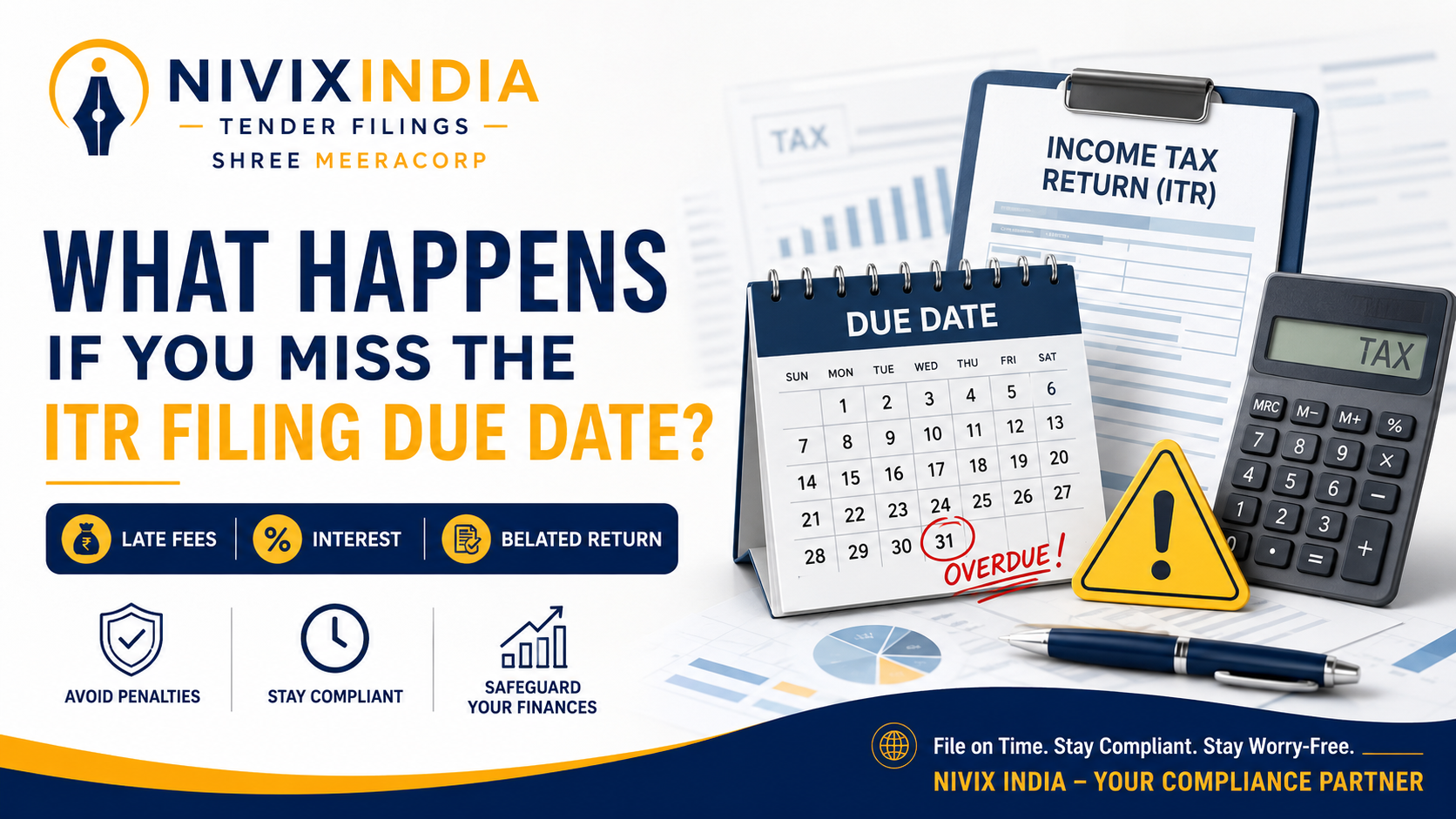
What Happens If You Miss the ITR Filing Due Date?
Filing your Income Tax Return (ITR) on time is important for every taxpayer. Timely filing helps you avoid penalties, receive refunds faster, and maintain proper tax compliance. If you miss the prescribed ITR filing due date, you may still be able to file a belated return, but late filing can result in extra costs and the loss of certain benefits.
Under the income tax filing system, returns can be filed under different sections such as section 139(1) for filing on or before due date and section 139(4) for belated filing.【turn991797view0†L74-L78】
Can You Still File Your ITR After the Due Date?
Yes. If you miss the original due date, you can generally still file a Belated Return within the permitted time under the Income-tax provisions. However, filing late may lead to penalties, interest, delayed refunds, and other compliance-related issues.
Consequences of Missing the ITR Filing Due Date
1. Late Filing Fee under Section 234F
If you file your ITR after the due date, a late filing fee may apply:
₹5,000 if your total taxable income exceeds ₹5 lakh
₹1,000 if your total taxable income is ₹5 lakh or below
In general, no late filing fee applies if your total income is below the basic exemption limit
This is one of the most common consequences of missing the ITR filing deadline.
2. Interest on Outstanding Tax under Section 234A
If you have unpaid tax liability, interest may be charged on the outstanding amount.
Interest is generally charged at 1% per month or part of a month
It is calculated from the original due date until the date of actual filing/payment
So, if tax is still payable, late filing can increase your total outflow.
3. Possible Restriction on Choosing the Old Tax Regime
This point should be written carefully.
The new tax regime is the default regime in the ITR form, and in relevant cases the option to choose the old regime requires proper compliance within the prescribed due date and procedure.【turn991797view0†L95-L96】
The official ITR form for AY 2026–27 also shows that filing status and regime selection are linked to the due-date framework and prescribed form compliance.【turn991797view0†L74-L78】【turn991797view0†L95-L96】
So, a safer and more accurate way to write this is:
In some cases, eligible taxpayers may lose the option to choose the old tax regime if the required option is not exercised within the prescribed time.
4. Loss of Carry Forward of Certain Losses
If the ITR is filed after the due date, you may lose the benefit of carrying forward certain losses, such as:
Business losses
Capital losses
Stock market losses
However, some exceptions may apply under the Income-tax Act, such as house property loss in certain situations.
5. Delay in Refund Processing
If you are eligible for an income tax refund, late filing may delay the processing and credit of your refund. Filing on time usually helps in faster return processing and quicker refund issuance.
How to Avoid These Consequences
To make your ITR filing smooth and hassle-free:
File your ITR well before the due date
Keep all required documents ready in advance
Choose the correct ITR form
Match your details with Form 26AS, AIS, and TIS
Review salary, bank interest, capital gains, and other income carefully
Complete the e-verification process after filing
The Income Tax Department portal also provides taxpayer services and guidance for different categories such as salaried individuals and business/profession taxpayers.【turn991797view1†L57-L72】
Pro Tip
Before submitting your ITR, always cross-check:
PAN and Aadhaar details
TDS entries
Salary and interest income
AIS and TIS data
Bank account information
Deductions and exemption claims
This helps reduce errors, avoids mismatches, and lowers the chances of receiving tax notices later.
Final Thoughts
Missing the ITR filing due date does not always mean you cannot file your return, but it can create unnecessary financial and compliance problems. Late filing may lead to a fee, interest, delayed refund, and loss of certain benefits. That is why it is always better to prepare documents early and complete your return before the deadline.
If you are unsure about due dates, tax regime selection, or the correct ITR form, it is best to review the latest rules on the Income Tax Department portal or take professional assistance.
Need Help with ITR Filing?
Nivix India helps individuals, professionals, and business owners with
ITR Filing
Tax Compliance
Documentation Support
Return Review and Error Checking
Contact Nivix India today for smooth and accurate ITR filing support.
FAQs
1. Can I file my ITR after the due date?
Yes. You can generally file a belated return after missing the original due date, subject to the applicable rules and timelines.
2. What is the late filing fee for ITR?
A late filing fee under Section 234F may apply, depending on your taxable income.
3. Will I have to pay interest on unpaid tax?
Yes. If tax is still payable, interest under Section 234A may be charged on the outstanding amount.
4. Can late filing affect my choice of tax regime?
In some cases, yes. The new tax regime is the default, and opting for the old regime may require compliance within the prescribed due date and procedure in relevant cases.【turn991797view0†L95-L96】
5. Will late ITR filing delay my refund?
Yes. Filing late can delay refund processing and credit.
Income Tax | ITR Filing | Tax Compliance
What Happens If You Miss the ITR Filing Due Date
Missing the ITR filing due date can lead to late filing fees, interest on unpaid tax, delayed refunds, and loss of certain tax benefits. This guide explains what happens if you file your Income Tax Return late and how to avoid unnecessary penalties.
