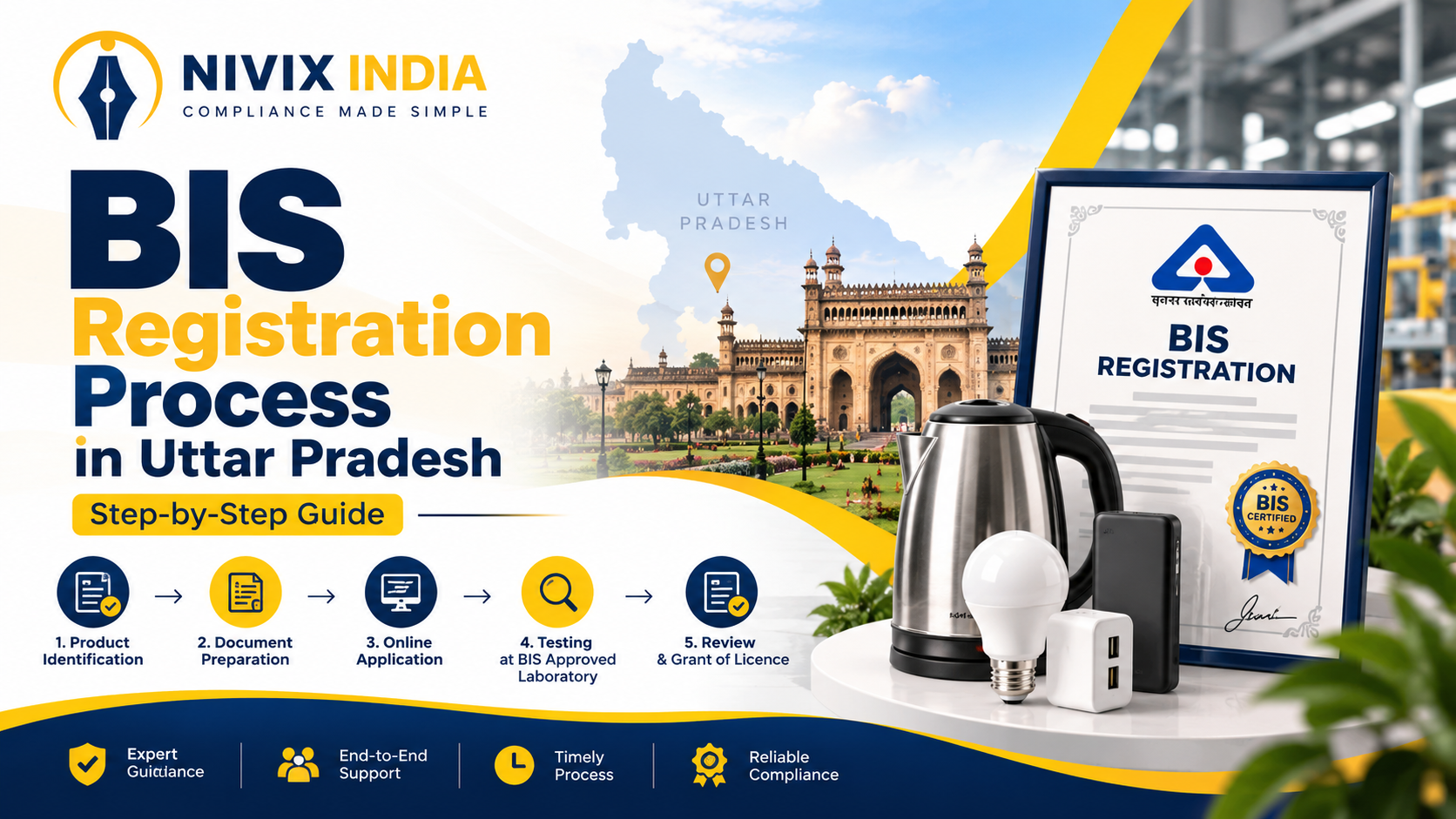
Bureau of Indian Standards (BIS) is India's national standards body responsible for developing and promoting quality standards for products. BIS certification helps ensure that products comply with the applicable Indian Standards and meet prescribed quality and safety requirements.
Manufacturers and businesses operating in Uttar Pradesh, including Lucknow, Kanpur, Noida, Ghaziabad, Agra, and other industrial areas, may need BIS certification depending on the products they manufacture or supply.
However, BIS registration requirements are not the same for every product. Some products require an ISI Mark licence under Scheme-I, while certain electronics and IT products fall under the Compulsory Registration Scheme (CRS). Therefore, identifying the correct certification scheme is the first step.
What Is BIS Registration?
BIS Registration is a process through which eligible manufacturers obtain the applicable licence or registration to demonstrate that their products comply with the relevant Indian Standards.
Depending on the product category, BIS conformity assessment may involve product testing, factory inspection, quality control verification, or submission of prescribed documents and test reports.
For products covered under mandatory Quality Control Orders (QCOs) or other compulsory certification requirements, businesses must follow the applicable rules before manufacturing, importing, distributing, or selling those products.
Step-by-Step BIS Registration Process in Uttar Pradesh
Step 1: Identify the Applicable Indian Standard
The first step is to identify the Indian Standard applicable to your product. The standard depends on the product's specifications, category, and intended use.
Manufacturers should verify whether their product falls under mandatory BIS certification and determine the relevant scheme before preparing an application.
Step 2: Select the Correct BIS Certification Scheme
BIS offers different conformity assessment schemes for different products. Common examples include:
- Scheme-I: Product certification generally associated with the ISI Mark.
- Scheme-II (CRS): Compulsory Registration Scheme for notified products, including specified electronics and IT goods.
- Other applicable schemes: Certain products may fall under Scheme-IV, Scheme-X, or other notified requirements.
The applicable scheme should always be confirmed against the latest BIS requirements and relevant government notifications.
Step 3: Prepare the Required Documents
Applicants should prepare the documents required for their particular product and certification scheme. Common documents may include:
- PAN card and identity proof of the authorised person
- Business registration certificate or incorporation documents
- GST registration certificate, where applicable
- Manufacturing unit address proof
- Product specifications and technical details
- Relevant Indian Standard details
- Product test reports from an accepted laboratory, where required
- Factory layout and manufacturing process details, where applicable
- Quality control and testing equipment details, where applicable
- Authorisation letter and prescribed undertakings or declarations
The final checklist may differ for domestic manufacturers, foreign manufacturers, and different product categories.
Step 4: Arrange Product Testing
Product testing is a key part of many BIS certification procedures. The product must be tested according to the applicable Indian Standard and the requirements of the relevant scheme.
For CRS applications, applicants generally need a test report from a BIS-recognised laboratory. Applicants should also check the applicable test-report validity period before filing.
For other certification schemes, the testing procedure may involve laboratory testing, factory inspection, or testing arrangements specified by BIS.
Step 5: Register on the Applicable BIS Portal
After preparing the required information, the applicant must use the official online portal applicable to the selected scheme.
For general product certification, applicants can refer to the BIS Manak Online portal. CRS applicants should follow the dedicated CRS portal procedure.
The applicant must enter accurate business, manufacturer, product, and technical details and upload the required documents in the prescribed format.
Step 6: Submit the Application and Pay the Applicable Fees
Once the application is complete, the applicant must submit it through the relevant portal and pay the applicable government fees.
The total cost may depend on the certification scheme, testing charges, inspection requirements, licence or registration fees, and other applicable expenses. Therefore, businesses should obtain a product-specific fee estimate rather than relying on a single fixed amount.
Step 7: Respond to BIS Queries and Complete Inspection Requirements
BIS may scrutinise the application and raise queries if documents or technical information are incomplete.
For schemes requiring factory inspection, the applicant must ensure that the manufacturing unit, quality control system, production process, and testing facilities meet the applicable requirements.
Applicants should respond to queries promptly and provide accurate supporting documents to avoid unnecessary delays.
Step 8: Obtain BIS Licence or Registration
After the applicable checks, testing, document verification, and other requirements are satisfactorily completed, BIS may grant the relevant licence or registration.
Applicants should verify the certificate details, product scope, brand or model coverage, and validity conditions before using the applicable BIS Standard Mark or registration details.
Businesses must follow the relevant marking, labelling, surveillance, and renewal requirements after approval.
Documents Required for BIS Registration in Uttar Pradesh
The documents depend on the product and certification scheme. A typical checklist may include:
- Business incorporation or registration documents
- PAN card and GST certificate, where applicable
- Manufacturing unit address proof
- Product technical specifications
- Applicable Indian Standard details
- Product test report, where required
- Manufacturing process and quality control documents, where applicable
- Details of testing equipment and manufacturing facilities, where required
- Authorisation letter and prescribed declarations
- Other product-specific documents requested by BIS
Applicants should confirm the official checklist before submitting their application.
How Long Does BIS Registration Take?
The processing time depends on the applicable certification scheme, product category, completeness of the application, laboratory testing, factory inspection, and resolution of any queries.
Some CRS applications may be processed within the normal timelines published by BIS, while other certification procedures can take longer due to additional testing or inspection requirements. No fixed approval timeline should be assumed for every product.
Submitting complete documents and responding promptly to official queries can help reduce avoidable delays.
Conclusion
The BIS Registration process in Uttar Pradesh begins with identifying the applicable Indian Standard and certification scheme. Applicants must then prepare the required documents, complete applicable product testing, submit the online application, pay the prescribed fees, and fulfil any inspection or verification requirements.
Need Help With Tender Filing?
Get expert assistance for tender search, documentation, eligibility checks and bid submission.
